IVF Embryo Grading Explained: What It Means for Your Success Rates
IVF embryo grading is a system used by embryologists to evaluate embryo quality based on development stage and cell structure. It includes a number (1–6) for blastocyst expansion and two letters (A–C) for cell quality. Higher-grade embryos like 4AA or 5AA generally have better implantation potential, but even 3BB embryos can lead to successful pregnancies.
Couples undergoing IVF often receive an embryo report with grades like 4AA, 3BB, or 5AB, which can be confusing. These combinations often raise questions about embryo quality and chances of getting pregnant.
Embryo grading is based on developmental stage and structural quality, and it helps identify which embryos have the greatest potential for implantation and pregnancy success.
In this blog, we will break down how embryo grading works, what these grades mean, and how embryo quality can influence IVF success rates.
What is Embryo Grading?
Embryo grading is a way to check the quality of embryos during IVF. In the lab, embryologists look at each embryo under a microscope and observe how it is growing. They do not touch or harm the embryo this process is only for observation.
Embryos can look different from each other. Some may look more even and well-shaped, while others may look slightly uneven. However, even embryos that are not perfect in appearance can still grow normally and lead to a successful pregnancy.
IVF Embryo Grading Chart: Understanding Embryo Quality
For IVF, embryos grow in labs, during which specialist embryologists check the formation and development of embryos by looking through microscopes.
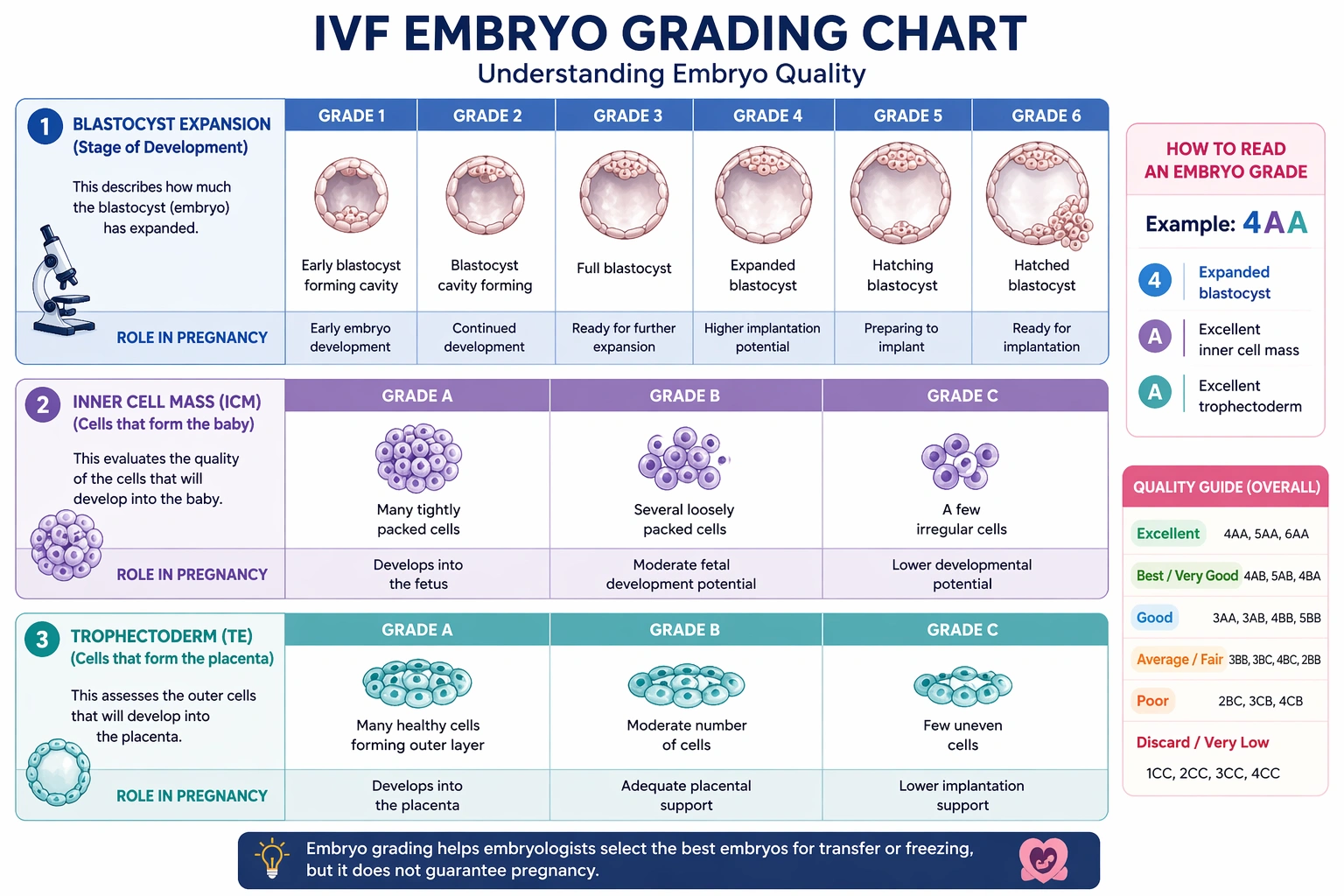
The majority of fertility clinics grade embryos using the Gardner Blastocyst Grading System. This calculates embryos’ grades using three criteria:
- Stage of blastocyst expansion
- Quality of the inner cell mass
- Quality of the trophoblast
The combination of these three grades creates grades for embryos like 5AB, 4AA, and 3BB.
IVF Embryo Grading Chart (Lab-Style Table)
Embryologists use this grading system to determine which embryos are most suitable for transfer or freezing during IVF treatment.
How to Read IVF Embryo Grades?
Embryo grades consist of one number and two letters. For example: 4AA
This indicates that the embryo is well developed with strong fetal and placental cell quality.
4AA vs 3BB Embryo: Key Differences
Many IVF patients want to understand the difference between embryo grades such as 4AA and 3BB, since these grades may appear in their IVF report.
Embryo Comparison Table
Although 4AA embryos are considered top quality, embryos graded 3BB can still lead to successful pregnancies and are commonly transferred in IVF cycles.
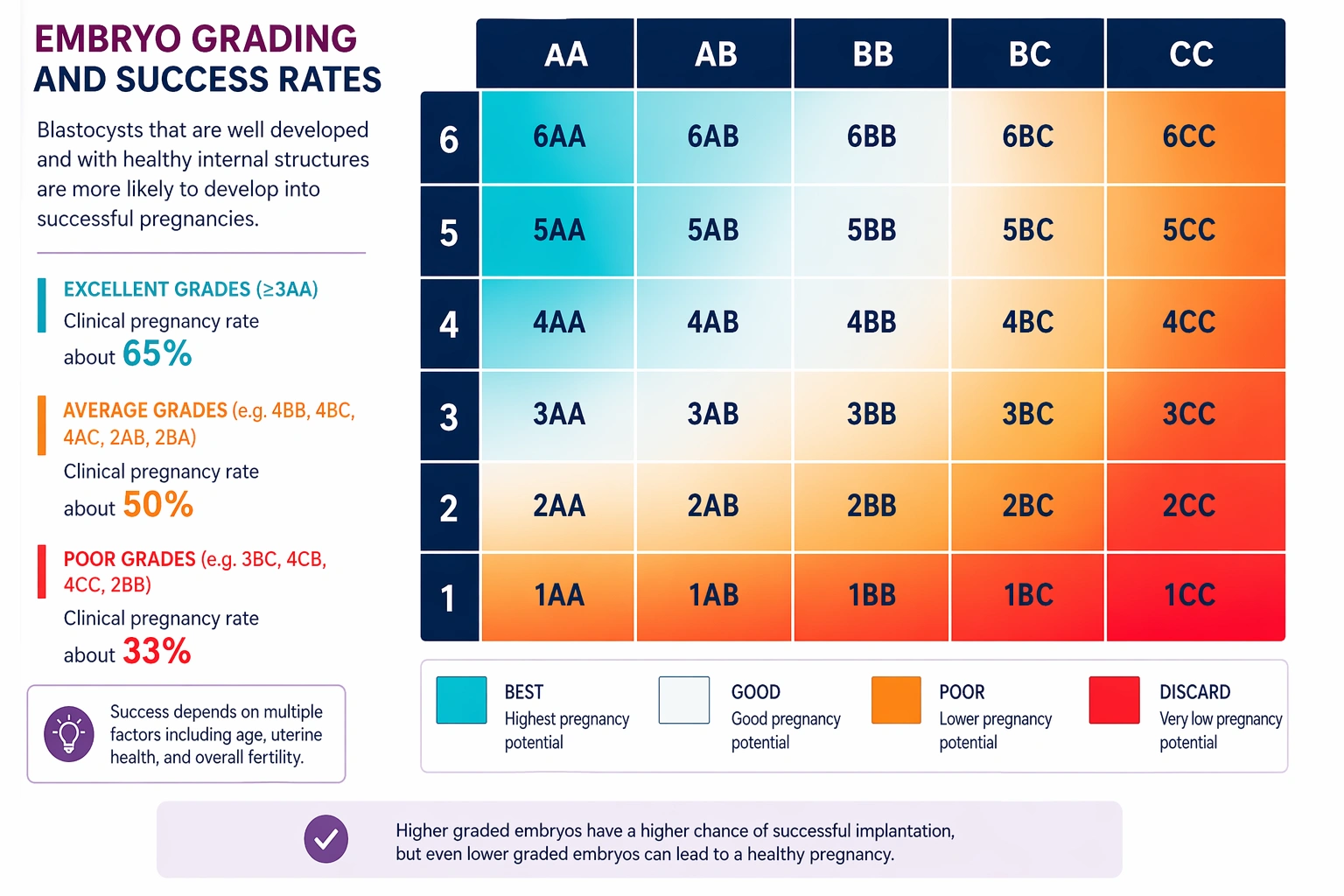
Embryo Quality Categories in IVF
To help patients understand embryo grades more easily, fertility specialists often group them into quality categories.
It is important to remember that embryo grading does not guarantee pregnancy, and even embryos with moderate grades may result in healthy pregnancies.
What Embryo Grading Cannot Predict?
Embryo grading is a helpful tool, but it cannot determine every aspect of IVF success.
For this reason, fertility specialists consider multiple factors when planning IVF treatment.
Why IVF Embryo Grading is Important for Success Rates?
Embryo grading helps doctors make important decisions during the IVF process.
FAQs About IVF Embryo Grading
Q. Is a 4AA embryo guaranteed to result in pregnancy?
Ans. No. A 4AA embryo has high implantation potential, but success also depends on factors like uterine health, maternal age, and embryo genetics.
Q. Can a 3BB embryo lead to a successful pregnancy?
Ans. Yes. Many successful pregnancies occur with 3BB embryos. While the implantation rate may be lower than top-grade embryos, they are still considered good quality.
Q. Which embryo grade is best for IVF?
Ans. Embryos graded 4AA, 5AA, or 6AA are generally considered top quality, but even lower grades can result in healthy pregnancies.
Q. Does embryo grading affect a baby's health?
Ans. No. Embryo grading only reflects appearance and development in the lab. It does not determine the long-term health of the baby.
Q. Should I transfer only the highest-grade embryo?
Ans. Usually yes, but doctors also consider other factors like genetic testing results and your medical history.
Q. Which is better, 4AA or 5AA?
ANS. Both 4AA and 5AA embryos are considered excellent quality, but a 5AA embryo is slightly more advanced in development. The number (4 or 5) represents the stage of blastocyst expansion, with 5 indicating a hatching embryo that is closer to implantation. However, in real clinical practice, both 4AA and 5AA embryos have very high implantation potential, and the difference in success rates is usually minimal
Q. Is a 4BB embryo better than a 3BB?
Yes, a 4BB embryo is generally considered better than a 3BB embryo. The number indicates the stage of development, and a 4 (expanded blastocyst) is more advanced than a 3 (full blastocyst). While both are classified as good-quality embryos, a 4BB embryo may have a slightly higher chance of implantation. That said, many successful pregnancies also occur with 3BB embryos.
Q. Are most 5AA embryos boys?
ANS. No, embryo grading (like 5AA) has no connection with the baby’s gender. The grade only reflects the embryo’s development and cell quality, not whether it is male or female. Gender is determined by the chromosome (X or Y) from the sperm, and it can only be identified through genetic testing (PGT), not by embryo grading.
Conclusion
Embryo grading is a valuable tool that helps fertility specialists assess embryo development and select the most suitable embryos for transfer. Grades such as 4AA or 3BB reflect the embryo’s stage and cell quality, but they do not guarantee pregnancy.
IVF success depends on multiple factors, including maternal age, uterine health, and genetic quality. Understanding embryo grading can help patients make informed decisions and approach treatment with realistic expectations.