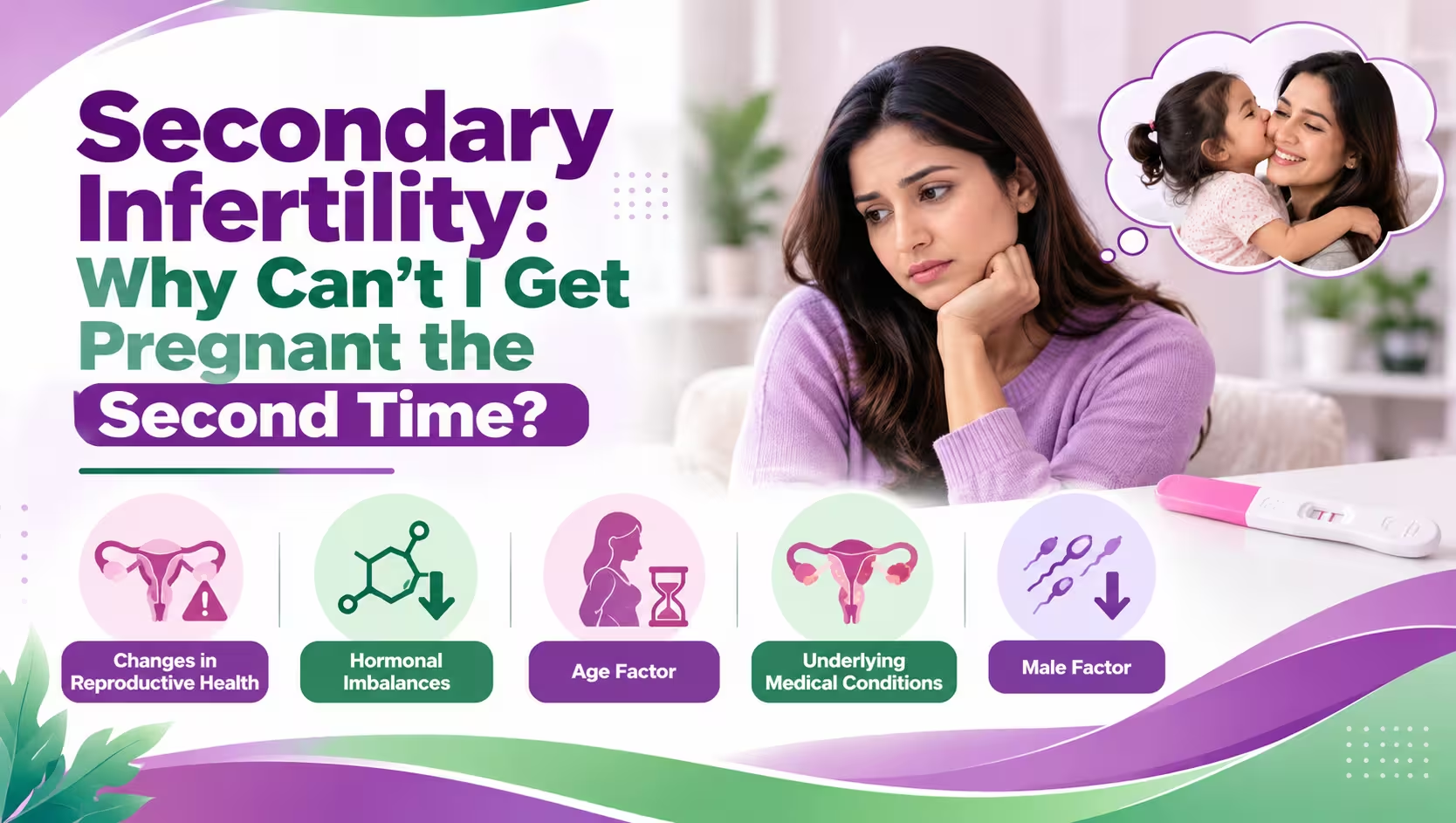
Secondary Infertility: Why Can't I Get Pregnant the Second Time?
Secondary infertility is the inability to get pregnant or carry a pregnancy to term after previously giving birth to a biological child without the help of fertility treatments like IVF.
Having a first baby without difficulty does not guarantee that conceiving again will be easy. Factors such as increasing age, hormonal changes, and sperm-related problems may affect the ability to conceive a second time.
In this blog, we will explore the causes of secondary infertility, how it is diagnosed, and the treatment options that may help couples trying to have another baby.
What Is Secondary Infertility?
Secondary infertility is the inability to conceive a child or carry a full-term pregnancy after previously giving birth to or conceiving a child without fertility treatment.
Having a successful pregnancy in the past does not guarantee that conceiving again will be easy. Factors such as age, hormonal changes, reproductive health, and sperm-related issues can affect either partner and contribute to difficulty conceiving again.
Secondary infertility is generally evaluated after 12 months of regular, unprotected intercourse if the woman is younger than 35, or after 6 months if she is 35 or older. Earlier evaluation may be recommended depending on age, medical history, and existing fertility concerns.
Why Can't I Get Pregnant the Second Time?
There are several causes of secondary infertility even if you did not experience any problems during the first pregnancy.
1. Aging and Egg Quality
Aging is another cause of infertility for females because, with age, the number of eggs a woman has declines, as well as their quality. Thus, even if the first pregnancy did not bring any problems, getting pregnant again can be much harder due to declining egg quality and quantity.
2. Ovulatory Disorders and Hormonal Imbalance
Hormones may cause infertility after a woman has already had her first baby. For example, polycystic ovary syndrome, thyroid disorders or any other hormonal imbalance might lead to irregular ovulation.
3. Alteration of Sperm Quality
There is also the possibility of male infertility. Age, illness, smoking, drugs and other health issues may alter sperm count, motility, and morphology. Past conception does not necessarily mean that there is no case of male infertility, so retesting sperm is essential.
4. Obstruction of Fallopian Tubes or Other Issues in the Uterus
Pelvic infection, endometriosis, fibroids, polyps in the uterus and internal scarring in the uterus may impede conception. Sometimes, surgery or complications from a previous pregnancy may be responsible for these factors.
5. Body Weight and Other Changes in Lifestyle
Changes in body weight, smoking, heavy drinking, and certain illnesses may have an influence on reproductive health. It is possible to improve one’s health through addressing these problems; however, it may not solve every infertility issue.
What Are the Signs of Secondary Infertility?
Secondary infertility is characterized by the inability to conceive a baby after having had a pregnancy before. There could be other symptoms of fertility issues, like:
- Irregular or missing menstrual cycles.
- Intense pain during menstruation or lower abdominal pain.
- Ovulation irregularities.
- History of infections of the pelvic region or reproductive problems.
Nevertheless, many couples don't have any symptoms except for difficulty conceiving. Previous successful pregnancy is not an obstacle for you to seek medical consultation if conception is taking longer than expected.
How Is Secondary Infertility Diagnosed?
Fertility specialists usually assess both partners and determine possible reasons for the difficulty conceiving and provide suitable treatment options. This investigation includes:
Medications, history of pregnancies, deliveries, operations, and any changes in the patient's health status.
- Ovulation investigation - assessing the menstrual cycle and ovulation process.
- Sperm analysis: assessing the number of sperm cells, their motility and morphology.
- Hormonal investigation – checking the levels of hormones that are required.
- Pelvic ultrasound: checking the condition of the uterus and ovaries.
- HSG – determining whether the fallopian tubes are open.
Not everybody requires all these investigations. The fertility specialist chooses the investigation procedure considering the age, symptoms, history of health problems, and pregnancy.
What Are the Treatment Options for Secondary Infertility?
The treatment is selected based on the reason for infertility, the woman’s age, the period of infertility and the results of fertility tests in both partners.
1. Lifestyle Changes and Medical Management
Lifestyle changes that help maintain a normal weight, stop smoking and control existing health disorders are beneficial but may not solve some reproductive issues independently.
2. Drugs that Induce Ovulation
In case of an irregularity in ovulation, a doctor may prescribe medicines to trigger the ovaries’ egg production. The process requires professional monitoring.
3. Intrauterine Insemination (IUI)
This procedure involves injecting prepared sperm into the uterine cavity around the period of ovulation. This option can be considered by selected couples.
4. In vitro Fertilization (IVF)
The treatment of choice may include IVF in case there is no chance of success with other methods or in case other treatments were unsuccessful. In the course of the procedure, eggs are retrieved from the ovaries, fertilized in the laboratory and one embryo is introduced into the uterine cavity.
The choice of the optimal treatment is individual. Not all couples with secondary infertility need IVF and success cannot be guaranteed.
When Should You Consult a Fertility Specialist?
Get tested for your fertility if you are younger than 35 years old and have been trying to conceive for twelve months, or between 35 and 40 years old and have been trying for six months. Being over 40 years old will require immediate testing. Early fertility testing can be sought in case one has irregular menstruation, known fertility conditions, or any history of fertility issues.
Conclusion
Secondary infertility might come as an unpleasant shock and be emotionally stressful considering the fact that conceiving the first child was easy for you. Issues such as aging, hormonal disorders, sperm disorders and other factors influencing reproduction may contribute to the problem of being unable to conceive again. However, the good news is that diagnosis will be helpful in finding out possible reasons for that and offering appropriate treatment. If you are having trouble conceiving another child, it is recommended to see a fertility doctor. SCI IVF Hospital is a reputable IVF and Fertility center in India.
Frequently Asked Questions
1. Is it possible to experience secondary infertility when my first pregnancy was perfectly fine?
Yes, because there can be many reasons such as age, hormonal problems, poor sperm quality or other conditions that can affect fertility. A previous pregnancy is not an indicator that future pregnancies will be easy.
2. What is the most frequent reason for secondary infertility?
It depends on the particular situation; there is no universal reason.
3. Is secondary infertility treatable?
Yes, it can be managed with the help of medical treatment, medicines to induce ovulation, insemination, and surgeries, among others.
4. Can a man get infertility issues after he already had a child?
Yes, because sperm health might be affected by certain medical issues, taking medication, age and lifestyle, for example. Semen analysis can be done in order to determine the current sperm condition.
5. How long should I wait before consulting a specialist?
One year if you are younger than 35; six months if between 35 and 40; earlier if older than 40 or have any fertility issues.