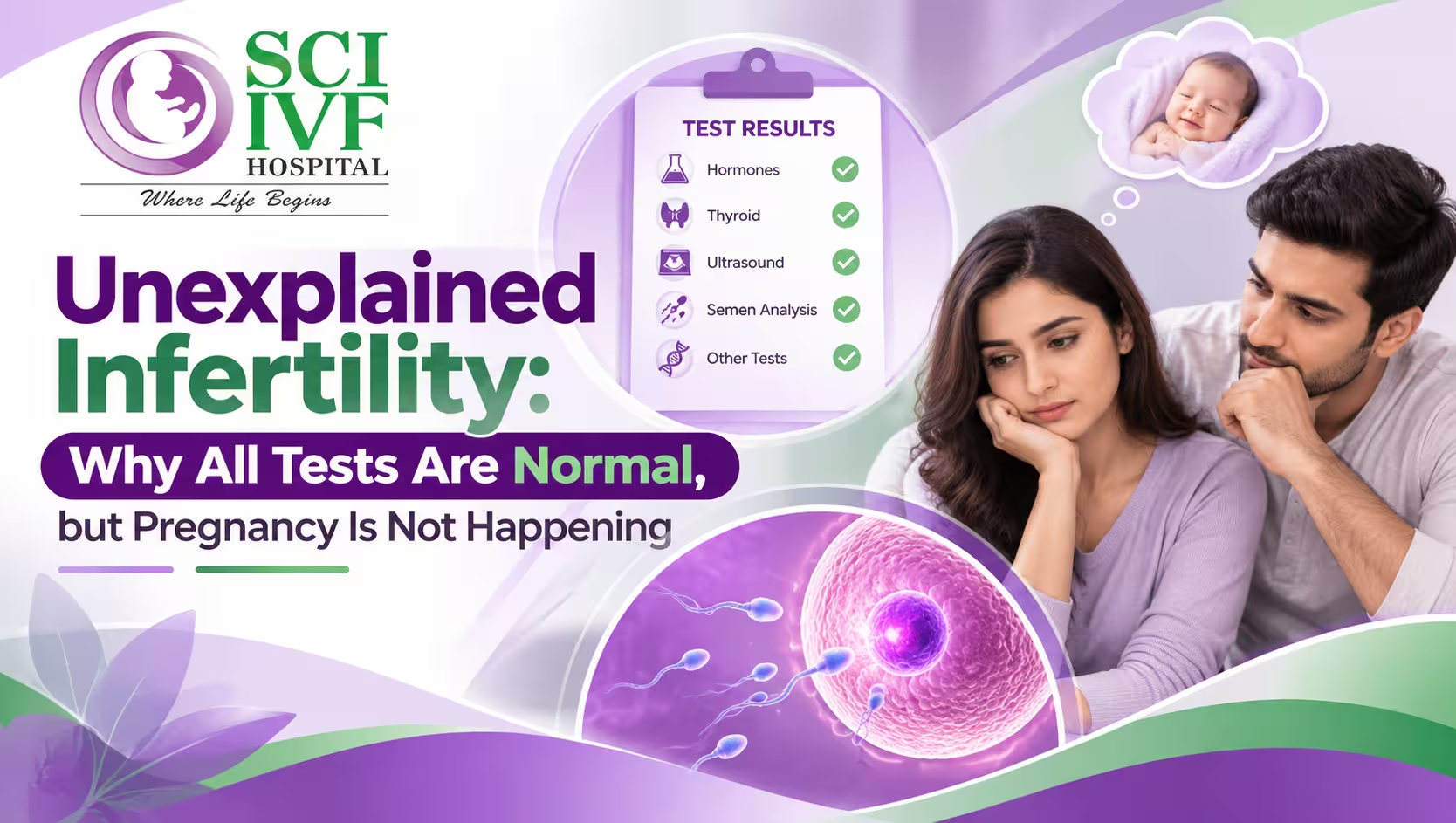
Unexplained Infertility: Why All Tests Are Normal, but Pregnancy Is Not Happening
Unexplained infertility means a couple cannot conceive after 12 months of regular, unprotected intercourse, or after 6 months if the female partner is 35 or older, even though standard fertility tests show normal results. It accounts for approximately 10% to 30% of infertility cases.
Trying to conceive without understanding why pregnancy is not happening can be emotionally challenging, especially when fertility reports appear normal. However, normal test results do not rule out every factor that may affect conception.
In this blog, we will explore what unexplained infertility means, why pregnancy may not occur despite normal fertility tests, and how it is diagnosed and managed.
What Is Unexplained Infertility?
Unexplained infertility is a diagnosis given when a couple cannot conceive after a year of regular, unprotected intercourse, or after six months if the woman is 35 or older, and standard fertility tests show normal results.
These tests typically evaluate ovulation, the uterus, fallopian tube function, and sperm health. A diagnosis of unexplained infertility does not mean that conception is impossible; it means that the investigations performed have not identified a clear cause of the difficulty conceiving.
Fertility involves several complex processes, including egg development, fertilization, embryo development, and implantation. Although standard tests assess many aspects of reproductive health, they cannot evaluate every factor involved in conception.
Why Am I Not Getting Pregnant When All Tests Are Normal?
Despite having normal findings on standard fertility tests, there are some reasons that could potentially be responsible for failure to conceive.
1. Eggs' Quality and Chromosomal Issues
Even if a woman ovulates regularly and has positive hormone test results, the quality of each egg is likely to differ. Age plays a crucial role since eggs tend to get worse with age. Standard fertility tests cannot provide information about the quality of each egg.
2. Male Sperm Function
Semen analysis measures the quantity, movement, and shape of sperm. Nevertheless, this test does not take into account all other aspects related to sperm function and embryo development. Normal results mean that everything seems fine; however, it does not mean that conception is going to happen.
3. Conception and Early Development of Embryos
Conception requires much more than only the release of an egg. There is an interaction between the egg and sperm; then fertilisation takes place, and an embryo starts to develop.
4. Subtle Factors Relating to Reproduction
Routine testing will not reveal all physiological problems that relate to the reproductive organs. Nevertheless, one should not always attribute unexplained infertility to the problem of implantation, immune response or any other factor which is not scientifically validated. Further tests are required only if there is a clinical need for the same.
5. Age and Time of Infertility
Age and period of infertility play a crucial role in determining the chances of spontaneous conception. In spite of normal reports, prolonged inability to conceive is certainly a condition that needs proper assessment.
How Is Unexplained Infertility Diagnosed?
A fertility doctor takes into account both partners’ medical history and finds out whether all required investigations have been done. Such investigations can include:
- Ovulation tests: To establish if eggs are produced and ovulation occurs regularly.
- Spermogram: For checking the sperm count, motility, and morphology.
- Ultrasound scanning: For examining the state of the uterus and ovaries.
- Fallopian tube examination: If necessary, HSG can be prescribed to establish whether the fallopian tubes are blocked.
- Required blood tests: Depending on the symptoms, certain hormone tests can be prescribed.
However, all possible tests are not necessarily required for each couple. Further tests should be conducted according to the results of the examination.
Can You Get Pregnant Naturally With Unexplained Infertility?
Yes, natural conception is also a possibility for those couples facing unexplained infertility, depending upon several factors such as the age of the female, the length of time the couple has been trying, and their reproductive history.
A fertility expert will be able to provide advice on whether or not it would be a worthwhile strategy to continue with natural conception or whether there is a possibility that treatment will help increase their chances of conceiving.
What Are the Treatment Options for Unexplained Infertility?
Management is based on the specific needs, preferences, and evaluation of fertility status in each couple.
1. Expectant Management
In the case of a reasonable possibility of spontaneous pregnancy, a couple can be advised to try to conceive for a certain amount of time under adequate monitoring.
2. Ovulation Induction with IUI
Clomiphene or letrozole along with intrauterine insemination (IUI) can be suggested. For IUI, processed sperm is inserted into the uterus around ovulation. This method can be applied for a selected group of couples.
3. IVF Therapy for Unexplained Infertility
In vitro fertilization (IVF) includes egg retrieval, fertilization with sperm in a lab setting, and transfer of one or more embryos to the uterus. This treatment can be indicated if other methods proved unsuccessful or because of age and clinical history.
As reported by the American Society for Reproductive Medicine, a short-term course of ovarian induction with IUI and following IVF is often used as a treatment strategy; however, optimal sequence of therapies varies individually.
When Should You Consult a Fertility Specialist?
One should undergo a fertility workup after one year of attempting to get pregnant when she is below 35 years old and half that time when she is between 35 and 40 years old. The latter age group may want an earlier evaluation. This should also be considered in case of having menstrual irregularities.
Conclusion
Unexplained infertility is certainly frustrating, especially when fertility tests seem normal. Nonetheless, just because fertility test results are normal does not mean that there are no factors affecting the ability to conceive. There are ways to address the issue. Through evaluation, you will be able to identify which options will work best for you, be it natural conception attempts, intrauterine insemination (IUI), or in vitro fertilization (IVF). SCI IVF Hospital provides fertility testing and tailor-made solutions. Get in touch with SCI IVF, which is regarded as the Best IVF and Fertility Center in India.
Frequently Asked Questions
1. Is it possible to have unexplained infertility if all the fertility tests are fine?
Yes. Unexplained infertility is characterized by the absence of a recognizable cause despite fertility difficulties through a series of routine tests.
2. Does unexplained infertility always require treatment?
Sometimes natural conception can happen. The probability depends on age, infertility period, and other individual fertility characteristics.
3. Is IVF treatment the best solution for unexplained infertility?
IVF is a good method of treatment, but there is no need to use this procedure for every couple. The specialist will determine what type of management is suitable.
4. Can unexplained infertility be caused by stress?
Stress can affect the emotional state and even affect lifestyle or sex life, but it should not be taken into account as the cause of infertility.
5. When should you start treatment?
You should undergo an examination after one year of infertility at age below 35, after half a year for women from 35 to 40 years, and immediately if older.