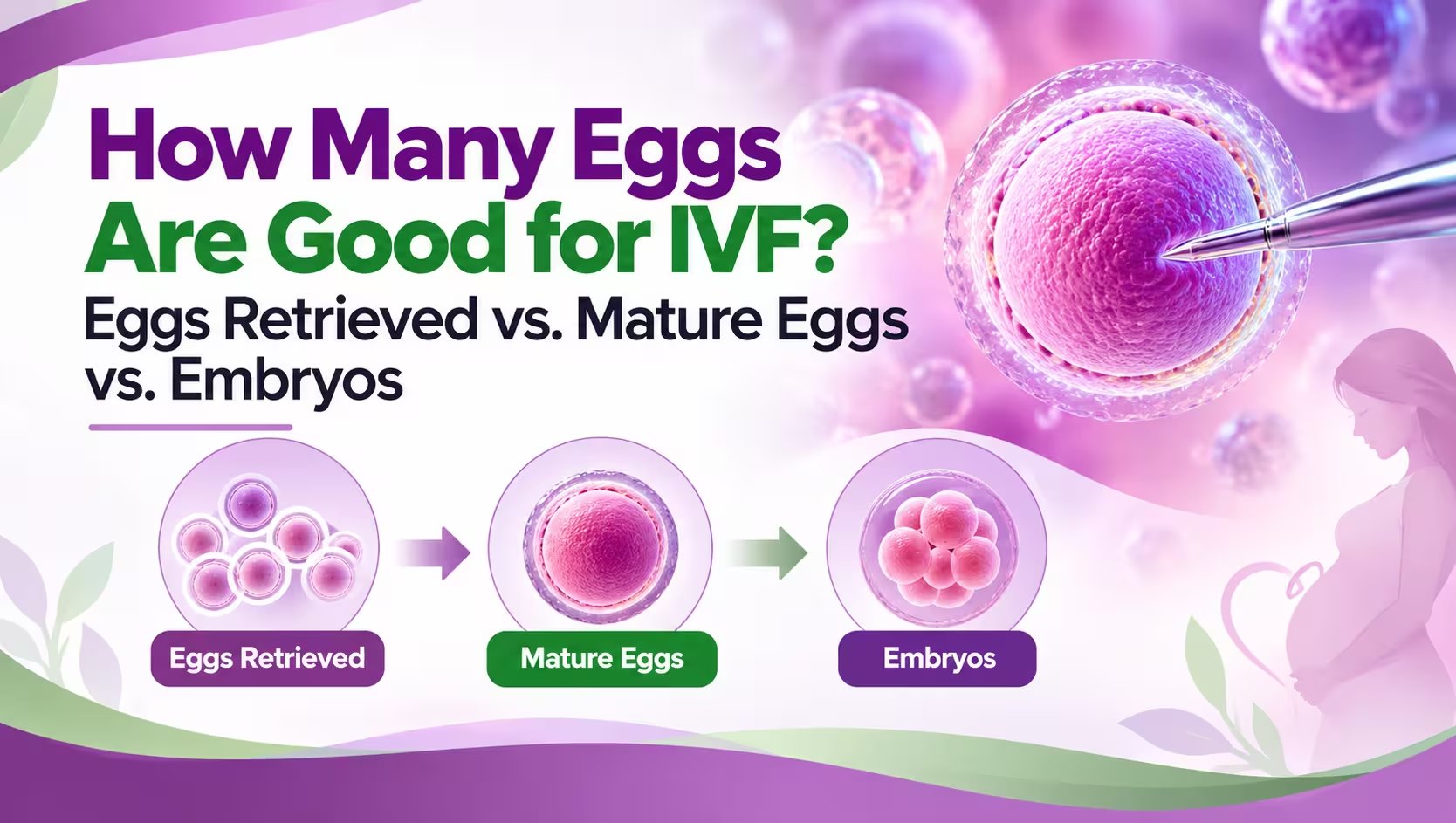
How Many Eggs Are Good for IVF? Eggs Retrieved vs. Mature Eggs vs. Embryos
For a successful IVF cycle, retrieving around 10–15 eggs, including approximately 10–12 mature eggs, may provide a good opportunity for fertilization and embryo development. However, there is no single ideal egg count for everyone. The number of eggs needed depends on several factors, particularly the woman's age, ovarian reserve, and response to fertility medications. Younger women generally have a higher chance of obtaining a chromosomally normal (euploid) embryo, while this probability tends to decrease with age.
Understanding the difference between eggs retrieved, mature eggs, fertilized eggs, and developing embryos can help intended parents set realistic expectations about IVF. This blog explains these stages and explores the key factors that may influence IVF outcomes.
How Many Eggs Are Good for IVF?
For a successful IVF cycle, retrieving around 10 to 15 eggs, including approximately 10 to 12 mature eggs, may provide a good opportunity for fertilization and embryo development. However, there is no single ideal egg count for every woman, as the number needed depends on factors such as age, ovarian reserve, and response to fertility medications.
Age is particularly important because younger women generally have a higher chance of obtaining a healthy, chromosomally normal (euploid) embryo than older women. Some women may achieve pregnancy with fewer eggs, while others may need additional IVF cycles.
Ultimately, IVF treatment focuses not only on the number of eggs retrieved but also on their maturity, fertilization, embryo development, and the individual’s overall treatment outcomes.
Eggs Retrieved vs. Mature Eggs vs. Embryos: What's the Difference?
Insight into the various stages involved in IVF makes it clear why the number of embryos in the end turns out to be less than the number of eggs obtained.
1. Egg Collection During IVF
Ovarian stimulation by fertility drugs results in the maturation of multiple follicles. The eggs are then harvested using the process known as egg collection.
Different women can have different numbers of eggs harvested, and some might be immature and thus not suitable for fertilisation.
2. Mature Eggs
Mature eggs are those that have matured up to a point where they can be fertilized. Such eggs are referred to as MII eggs. Not all eggs retrieved during egg harvesting will be mature.
The number of mature eggs is significant since conventional IVF and ICSI use mature eggs to fertilize.
3. Fertilized Eggs
In a traditional IVF procedure, the eggs and sperm are left to fertilize each other in the laboratory dish. In case of ICSI, a single sperm is directly injected into the egg.
Not all mature eggs may fertilize successfully. The embryo specialists check for successful fertilization before moving on to further monitoring.
4. Embryos and Blastocysts
Once fertilization occurs, the growing eggs are called embryos. Embryos are kept under observation in the laboratory while dividing.
Some embryos become blastocysts which occur typically after 5-6 days. Some of the blastocysts can be either transferred or frozen based on their developmental status. Not all fertilized eggs reach this point.
According to the American Society for Reproductive Medicine, this natural reduction in numbers takes place at every step of the IVF procedure.
How Many Eggs Usually Become Embryos During IVF?
In a typical IVF cycle, out of 10 to 15 eggs retrieved, approximately 7 to 10 may fertilize, and around 1 to 3 may develop into transfer-ready blastocysts (Day 5 embryos). However, these numbers are estimates and can vary considerably from one cycle to another.
Not all retrieved eggs are mature enough for fertilization, and not all fertilized eggs continue developing to the blastocyst stage. Factors such as the woman's age, egg and sperm quality, laboratory conditions, and the IVF protocol can influence embryo development.
Having fewer eggs or embryos does not necessarily mean IVF will fail. Even one suitable embryo may result in pregnancy, although success is never guaranteed.
What Factors Affect the Number of Eggs Retrieved During IVF?
There are several determinants affecting the number of eggs harvested from an IVF cycle.
1. Age of the Woman
Both the quality and quantity of eggs are affected by age. With age, the ovarian reserve gets reduced and the chances of chromosomal abnormalities increase. This is not consistent and some women have normal egg quantities irrespective of age.
2. Ovarian Reserve and Anti-Müllerian Hormone (AMH)
The level of AMH as well as the antral follicle count (AFC) helps the fertility specialists predict the potential ovarian response. Though the tests provide a hint about egg retrieval, they cannot independently help in determining the success of IVF treatment.
3. Polycystic Ovary Syndrome (PCOS) and Other Medical Conditions
Some women suffering from PCOS have multiple follicles that might show great responsiveness to stimulation drugs. Others have lower ovarian responsiveness because of poor ovarian reserve.
4. Individual IVF Stimulating Protocol
The protocol for stimulating ovaries differs from one fertility specialist to another depending on several factors.
5. IVF Cycle Response History
Where the woman has had experience with an IVF treatment previously, the egg retrieval quantity and quality are used by the specialist to determine future treatment protocols.
Does Having More Eggs Increase IVF Success Rates?
It means that if one has more eggs, he/she will have greater chances of harvesting mature eggs, fertilized eggs and embryos. But the number of eggs is not a criterion of success. Other factors such as the quality of eggs, their age, sperm health, embryo growth and condition of the uterus affect the results.
A high number of eggs does not imply that these eggs are better in quality. Safety is also a very important issue here. There are some women who can develop ovarian hyperstimulation syndrome due to high sensitivity to fertility drugs.
It is crucial to maintain an optimal ovarian response taking into account not only the number of eggs, but also the safety of a woman.
How Many Embryos Should Be Transferred During IVF?
The quantity of embryos produced through the IVF process is not the same as the number transferred to the womb during a single process.
For the right cases, single embryo transfer is advised in most cases as it will decrease the chances of having twins or multiple babies. The single embryo transfer may lead to a successful pregnancy even though there is no guarantee.
It depends on certain factors like age, development of embryos, and previous experiences with the treatment among others. You can discuss this with your fertility expert for more details.
How Can You Support Better IVF Outcomes?
Though there is no lifestyle intervention that can ensure a successful IVF procedure, there are steps that you can follow to improve your general well-being and fertility program:
- Attend recommended fertility assessments and checkups
- Observe your prescribed medical regimen
- Eat a healthy and balanced diet and maintain your weight
- Quit smoking and consult your fertility specialist regarding your drinking habits
- Take folic acid or other dietary supplements as per your doctor’s advice
- Talk to your fertility specialist about your ovarian reserve, expected number of eggs, and treatment options
Do not compare the number of your eggs with someone else's, as everybody’s ovarian response and fertility situations vary.
Conclusion
Egg retrieval for IVF is just the tip of the iceberg in the fertility process. The availability of mature eggs, fertilization success, and embryo formation all make up parts of the probability of conception. Though egg retrieval might give more options, there are still other important factors such as egg quality, age, ovarian reserve, and general well-being that must be considered. In case you are planning to undergo IVF, it is recommended that you seek advice from fertility experts to know what to expect. As an example, SCI IVF Hospital is known as the Best Fertility and IVF Center in India.
Frequently Asked Questions
1. How many eggs would be good for IVF?
About 10-15 eggs retrieved can be used as a guideline for some IVF treatments, but there is no single optimal number. Age, eggs’ maturity, eggs' quality, and each woman’s individual response to stimulation will play roles.
2. How many mature eggs should be used for IVF?
There is no certain number of mature eggs necessary for success. It can be as little as a few, as long as a proper embryo can be achieved. Individual fertility conditions will play a role in the outcome.
3. What is the difference between eggs and mature eggs?
The eggs are the ones that are collected from the ovaries. The mature eggs are the eggs that have reached the desired developmental stage necessary for fertilization in the process of IVF or ICSI.
4. Is it possible to perform IVF with two or three eggs?
Yes, it is possible. The number of mature eggs and individual factors will play their roles.
5. Is a high level of AMH equal to more eggs in IVF?
A high level of AMH can indicate that more eggs can be obtained after stimulation.