Periods and Fertility in the Menstrual Cycle
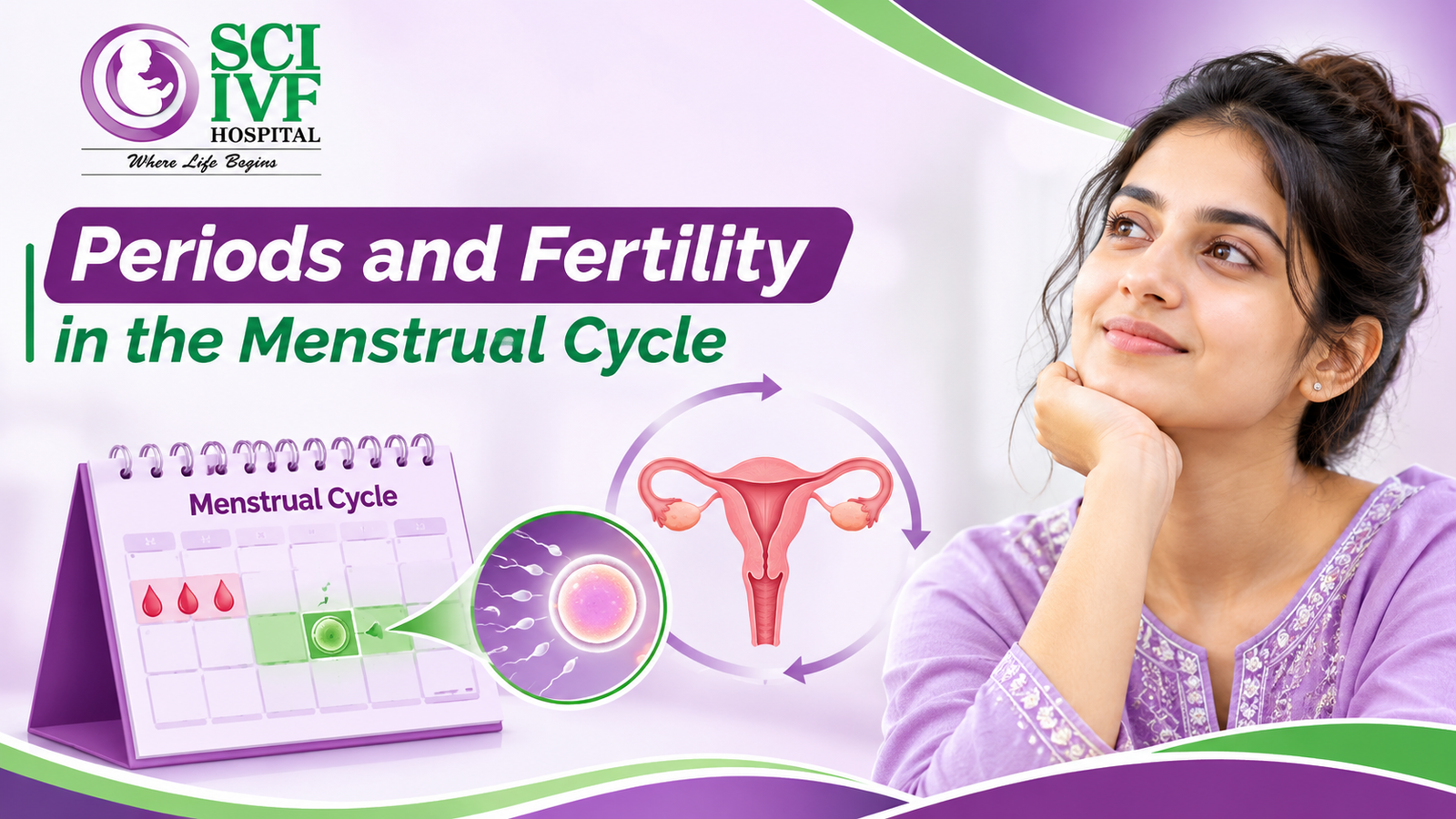
Fertility is highest during the fertile window—about 6 days total, spanning the 5 days before ovulation and the day of ovulation itself.
Understanding the Menstrual Cycle and Fertility
The menstrual cycle is a hormone-driven monthly process that prepares the body for potential pregnancy, typically lasting 21 to 35 days with an average of 28 days. Fertility peaks during a short fertile window—usually the five days before ovulation plus the day of ovulation itself—because sperm can survive for up to five days while a released egg remains viable for about 12 to 24 hours.
The Four Stages of the Menstrual Cycle
The process of the menstrual cycle involves four major stages and each involves hormonal changes affecting ovulation and fertility.
1. Menstrual Phase
It marks the first day of menstruation when the uterine lining sheds and passes out through the vagina in the form of bleeding. Menstruation normally lasts for 2-7 days.
The first day of menstruation is considered to be day one of the menstrual cycle.
2. Follicular Phase
The ovaries produce follicles in this stage, containing immature eggs. Oestrogen production increases, aiding in the development of the uterine lining.
The follicular stage begins with the first day of the menstrual cycle and ends at the time of ovulation.
3. Ovulation Phase
Ovulation is when a mature egg is released from one of the ovaries, taking place normally about 10-16 days prior to the next period (though the time may vary among different females).
The egg moves through the fallopian tube and remains available for fertilization for 12-24 hours.
4. Luteal Phase
After ovulation, progesterone level rises in order to prepare the uterine lining for the possibility of implantation. If this does not take place, the hormone level declines causing shedding of the uterine lining in the next menstruation cycle.
When Are Women Most Fertile?
During ovulation, women are at their most fertile as a mature egg is released from one ovary. This time frame is referred to as the fertile window.
The fertile window typically encompasses five days preceding ovulation and ovulation itself. This is due to the ability of the sperm to remain alive inside the female reproductive tract up to five days and for the egg to live within 12-24 hours after being released.
For instance, ovulation typically takes place on day 14 during a 28-day menstrual cycle; hence, the fertile window might be between days 9 and 14.
Nevertheless, ovulation is not always the same for every woman as different factors affect it.
Can You Get Pregnant on Your Period?
Certainly, despite the odds being slimmer, it is possible to become pregnant while on your period. This occurs if one has a shorter menstrual cycle or ovulates sooner than she had expected.
For instance, with someone having a shorter menstrual cycle, there are chances that ovulation will occur just a few days after her period ends. Sperm may live in the female body for some days; hence, it may still be alive by the time of ovulation.
Thus, having unprotected sexual intercourse during the menstrual period does not mean safety from pregnancy.
How Many Days After Your Period Can You Get Pregnant?
The number of days isn’t constant as the time for ovulation will be based on the length of your menstrual cycle.
In a normal 28-day cycle, the day that you ovulate falls around day 14, making the days before ovulation your fertile days.
In women who have short cycles, you might ovulate early and be fertile shortly after your period, while those with long cycles may ovulate late.
If conception is your goal, keeping track of your menstrual cycle will enable you to know your fertile days.
Signs That Indicate You Are in Your Fertile Window
There are some physical indications that occur during ovulation that will enable you to detect your fertile days. The physical signs are:
Vaginal discharges: There is a change in the consistency of the vaginal discharges that becomes clear, slippery, and stringy, like raw egg whites.
Pelvic pain: Some women experience slight pain or discomfort at the lower part of the pelvis.
Change in sexual libido: You might experience a change in your sexual appetite.
Change in basal body temperature: This involves an increase in body temperature after ovulation.
Positive ovulation test: It detects the presence of luteinizing hormone which occurs just before ovulation.
How to Track Your Menstrual Cycle and Improve Your Chances of Pregnancy
Knowledge about your cycle can aid you in determining your fertile days and planning for sexual intercourse. Some techniques that are useful include:
- Keep track of your periods on a calendar: Keeping track of the first and last days of your periods will help you determine your cycle length.
- Ovulation predictor kits: Ovulation predictor kits help detect the hormones present prior to ovulation.
- Cervical mucus: If your discharge is clear and stretchy, then it shows that ovulation is imminent.
- Keep track of your cycles: Keeping track of your periods for many months will help you know any patterns.
- Engage in regular intercourse: Regular intercourse every day or two during the fertile phase is useful for conception.
If your periods are irregular, then determining the time of ovulation using the calendar may prove to be hard. Fertility experts can advise you on the appropriate tests which can be carried out for ovulation.
Conclusion
Knowledge of periods, ovulation, and fertility can assist women to be well-informed on their reproductive issues.
Even though the probability of conceiving increases during the fertile period, it does not rule out the possibility of getting pregnant even during or immediately after periods, especially when there is early ovulation. Keeping track of your menstrual cycle will enable you to determine your fertile days to increase the probability of getting pregnant.
Nevertheless, cases of irregular periods or inability to conceive will require a medical examination. Should you need assistance with fertility, please visit SCI IVF Hospital, Best IVF & Fertility Center in India.
Frequently Asked Questions
1. Is it possible to conceive while menstruating?
Yes, though it is improbable because of early ovulation and sperm longevity.
2. How many days after your period will you be able to conceive?
This will depend on your cycle length and ovulation times.
3. What time within your menstrual cycle is it possible for you to conceive?
Conception is more probable during the fertile window – this includes the five days prior to ovulation and the day of ovulation.
4. During which part of the cycle are women more fertile?
Fertility is at its peak during ovulation as this is when the ovary releases the egg.
5. Will irregular menstruation affect your fertility?
Irregular periods will affect your ability to conceive as it means irregular ovulation.