What Is an Anechoic Cyst?
Seeing the term "anechoic cyst" on an ultrasound report can be worrying, especially when you're unsure what it means for your health or fertility. However, in most cases, an anechoic cyst is a simple fluid-filled cyst that is benign (non-cancerous) and harmless.
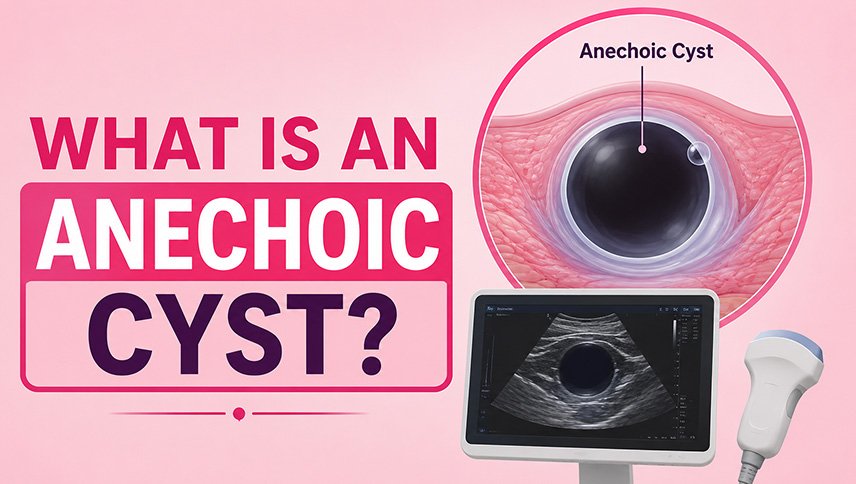
The term "anechoic" means "without echoes." On an ultrasound, these cysts appear completely black because the clear fluid inside does not reflect sound waves. Unlike complex cysts, a simple anechoic cyst typically has no solid components, thick walls, or internal debris, which are reassuring signs.
Anechoic cysts can occur in different parts of the body but are most commonly found in the ovaries during pelvic ultrasounds or fertility evaluations. Most simple anechoic cysts do not require treatment and may disappear on their own over time. In this article, we'll explain the meaning of an anechoic cyst, its causes, symptoms, diagnosis, treatment options, and whether it can affect fertility or pregnancy.
What Is an Anechoic Cyst?
An anechoic cyst is a fluid-filled sac that appears completely black on an ultrasound scan because the fluid inside does not reflect sound waves. The term "anechoic" simply means "without echoes," which indicates that the cyst contains clear fluid rather than solid tissue.
In most cases, anechoic cysts are benign (non-cancerous) and do not cause serious health problems. They are commonly discovered during routine ultrasound examinations and often do not require treatment. While anechoic cysts can develop in different parts of the body, they are most frequently found in the ovaries during pelvic ultrasound scans, fertility evaluations, or routine gynecological check-ups.
A simple anechoic cyst is generally considered harmless, but your doctor may recommend monitoring it based on its size, appearance, and any symptoms you may be experiencing.
What Causes an Anechoic Cyst?
Many factors may lead to an anechoic cyst.
Functional Ovarian Cysts
The most frequent factor is the occurrence of a functional ovarian cyst in connection with the normal menstrual cycle.
They are:
Follicular cyst – it happens when the follicle does not release the egg.
Corpus luteum cyst - it forms after ovulation.
In most cases, these cysts usually go away in several menstrual cycles.
Hormonal changes
Changes in the hormone levels during the menstrual period or ovulation may also lead to the formation of ovarian cysts.
Pregnancy
During early pregnancy, some women may experience the formation of a corpus luteum cyst. This particular type of cyst helps to maintain the pregnancy before the placenta takes over the function.
Endometriosis
Patients with endometriosis may develop ovarian cysts called endometriomas. In contrast to simple anechoic cysts, endometriomas usually have old blood and they appear differently on the ultrasound scan.
Polycystic Ovary Syndrome (PCOS)
Women with PCOS can have many small ovarian follicles. But these are not anechoic cysts.
Anechoic Cyst in Ovary: What Does It Mean?
The term "anechoic cyst" in the ovary is typically used to describe a simple ovarian cyst containing clear fluid.
In many cases, such ovarian cysts are formed normally during the process of ovulation and are not pathological.
Features of ovarian anechoic cysts include:
- Non-malignancy
- Asymptomatic nature
- No effect on female fertility
- Spontaneous disappearance within a few months
However, larger or more persistent ovarian cysts may need more detailed examination.
The ovarian cyst will be examined taking into account the following factors:
- Its size
- Form
- Ultrasound features
- Associated symptoms
- Age and reproductive state of the patient
Symptoms of an Anechoic Cyst
There are no signs in many women suffering from an anechoic cyst, and its presence becomes known only accidentally due to an ultrasound investigation.
Some of the signs are:
- Minor pelvic pain
- Soreness in the lower part of the belly
- Bloating sensation
- Feeling of pressure in the abdomen
- Sexual intercourse pain
- Irregularities in the menstrual cycle
- Frequent urge to go to the toilet if the cyst is big enough
If the cyst breaks or twists, there appear sharp pains in the pelvis, nausea, and vomiting.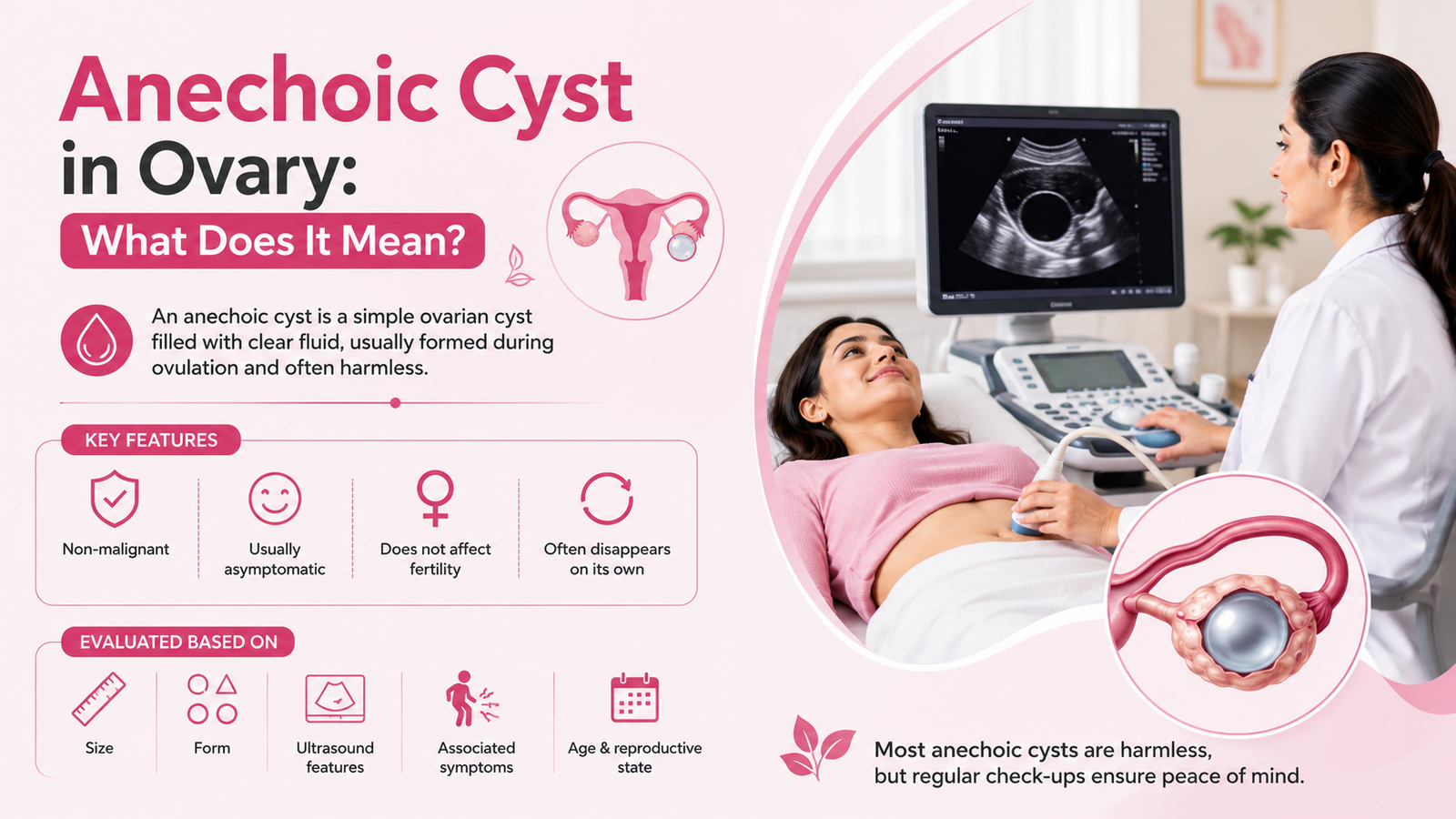
How Is an Anechoic Cyst Diagnosed?
The following tests are used by physicians for diagnosing an anechoic cyst.
Pelvic Exam
A pelvic exam may reveal an enlarged ovary or tenderness in the pelvis.
Ultrasonography(USG)
Ultrasonography (USG) is the primary test used to diagnose an anechoic cyst. Since the cyst contains clear fluid, it appears as a completely black area on the ultrasound image, helping doctors assess its size, location, and characteristics.
Transvaginal Ultrasound
With transvaginal ultrasound, the ovaries are seen better and this test is usually advised for women with pelvic pain and infertility issues.
Other Tests
According to your age, symptoms, and ultrasound results, other tests that could be performed by your physician include:
- MRI or CT scan (selected cases)
- Blood tests
- Tests for tumor markers if you have a complex cyst
Is an Anechoic Cyst Dangerous?
In most situations, no.
A basic anechoic cyst is typically harmless and needs no immediate attention.
But further assessment would be necessary if the cyst:
- Is quite large
- Lasts for a few months
- Has thick walls or solid parts
- Causes extreme symptoms
- Shows signs of changing over time
This doesn't automatically mean that it is cancer, just that it needs to be checked more carefully.
Anechoic Cyst Treatment
The right method for treating an anechoic cyst is determined by its size, symptoms and underlying cause.
Observation
Simple cysts are often left untreated because:
- A repeat ultrasound can be done after a few weeks/months
- Any change in cyst size is monitored
- No symptoms = No treatment
Medication
Painkillers are used to treat pain.
Certain hormonal medications like birth control pills are used to prevent cysts from forming, but will not treat the current cyst.
Surgery
Surgical intervention can be considered in cases of:
- Sizeable cyst
- Persistence despite observation
- Extreme pain
- Torsion or rupture
- Suspicious imaging results
In all cases, the aim should be to preserve the normal ovarian tissue as far as possible, especially in women desiring pregnancy.
Can You Get Pregnant with an Anechoic Cyst?
Yes. For some women who have an anechoic cyst in the ovary, pregnancy may occur without the use of assisted reproductive technology.
Simple ovarian cysts generally will not affect:
- Ovulation
- Fertilization
- Implantation
- Pregnancy
Nevertheless, the ability to conceive may be hindered when there is an existing cyst with complications such as endometriosis, PCOS, or ovarian injury.
When Should You See a Doctor?
Visit your doctor for consultation if you have:
- Pelvic pain persisting over time
- Severe pain in the abdomen
- Abnormal vaginal bleeding
- Swelling in the abdomen fast
- Fever along with pelvic pain
- Infertility problems
- An ovarian cyst that keeps growing
Timely medical attention will help in finding out if you need treatment and avoid any complications.
Conclusion
An anechoic cyst commonly appears in ultrasounds as a non-threatening fluid cyst. Though many women do not notice them, they typically disappear naturally and do not affect pregnancy or fertility.
For larger or painful cysts, a physician must be seen in case of other potential conditions. Many women reach out to a fertility specialist if they are concerned about ovarian anechoic cysts and how they may affect fertility.
At SCI IVF Hospital, we have numerous qualified professionals who aim to help you with your reproductive health through advanced imaging and diagnosis, as well as fertility exams and individualized treatment. We aid our patients in their reproductive health and in reaching their long-desired family-building goals.
Frequently Asked Questions
What is an anechoic cyst?
An anechoic cyst is a fluid-filled cyst that appears black when undergoing an ultrasound. This phenomenon occurs because the fluid is clear and does not echo sound waves.
Is an anechoic cyst cancer?
Most anechoic cysts are noncancerous and benign. Your doctor will review the cyst based on its size and shape as well as any added symptoms.
Can anechoic cysts go away on their own?
Yes, many ovarian cysts can resolve on their own and go away on their own within a few months without any medical intervention.
Can you get pregnant with anechoic cysts?
Yes, having simple ovarian cysts typically does not interfere with pregnancy, although other reproductive issues can affect your ability to get pregnant.
Do all anechoic cysts need to be surgically removed?
No, surgery is typically done on cysts that are large, painful, persist or that need to be removed for other reasons.